
Live Streaming Event Production in Colorado: What to Plan
A practical guide to venue readiness, camera coverage, sound, connectivity, show flow, and useful recordings for Colorado events.
Live production · MHMedia LLC · September 18, 2026
Let’s talk about your project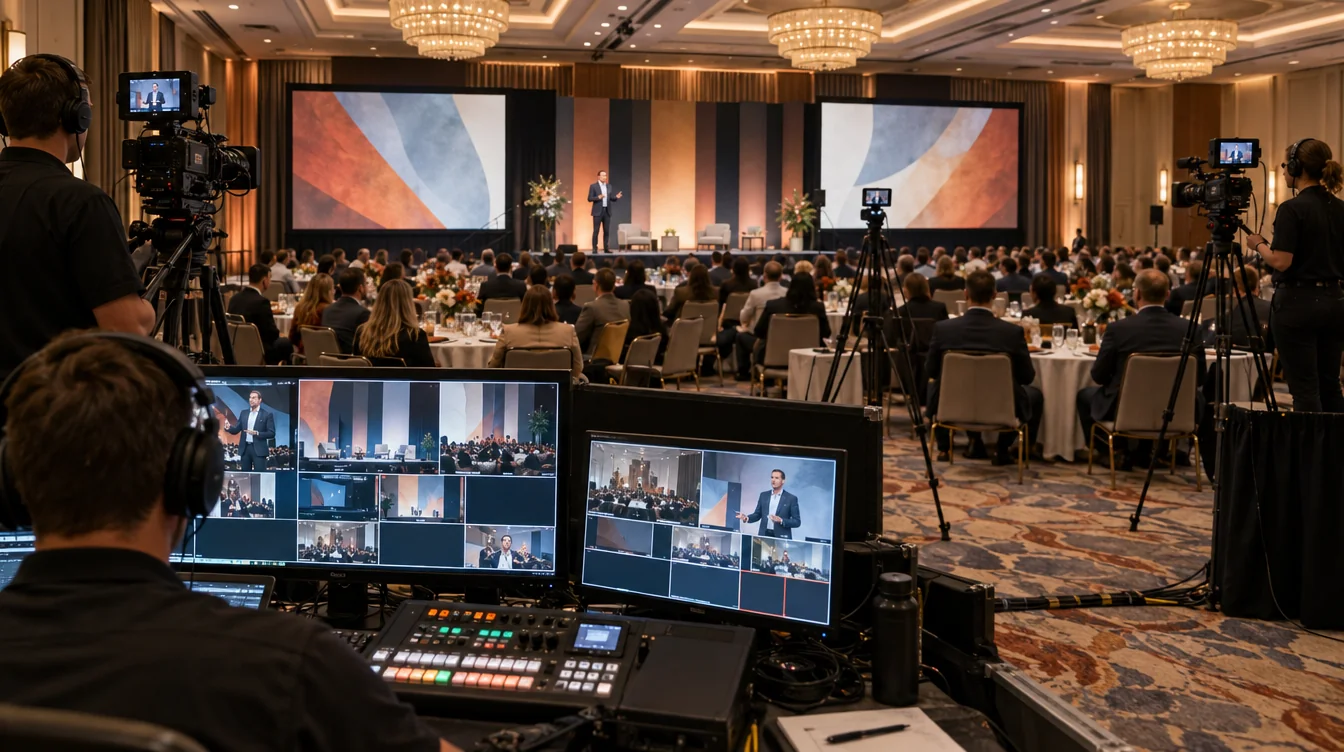
Live streaming event production in Colorado starts long before the program goes live. The remote audience needs to hear, see, and follow what is happening, while people in the room need an event that runs naturally. The production plan connects those two experiences and defines what should be recorded for use afterward.
Begin with the event outcome. Is the stream extending access to a presentation, connecting several locations, supporting a public program, or producing an episode of a recurring show? Estimate the in-person and remote audiences, identify the viewing platform, and decide whether remote interaction is part of the format.
Give the production team a real run of show
A schedule lists times; a run of show explains what changes at each moment. Include speaker names, entrances, videos, slides, awards, audience questions, breaks, graphics, and who gives each cue. Mark any portion that should not be streamed or recorded. If the event is a recurring or formatted program, MHMedia’s TV show production service can help create a repeatable structure for hosts, guests, crew, and viewers.
Camera coverage should follow the program. A keynote may need a clear speaker angle, presentation content, and enough audience context to keep the stream from feeling empty. A panel needs clean coverage of each participant and a plan for questions. Performances and demonstrations require different positions, rehearsal, and communication. Decide early where cameras can operate without blocking guests or creating unsafe cable paths.
MHMedia can operate two production teams simultaneously, with three cameras on each team. That capacity is useful only when the scope, venue, staffing, and schedule are matched to the event. Share concurrent rooms and program timing early so the production design reflects the actual need.
Treat sound as the foundation
Viewers may tolerate a less dramatic angle; they leave when they cannot understand the program. Identify every microphone, playback source, remote participant, and presentation computer. Determine whether the venue audio team will provide a feed and whether the stream needs a separate mix. A pre-event sound check should test actual presenters, videos, music, and remote connections rather than only confirming that a meter moves.
Presentation content also needs a route into the program. Collect final slides and videos in advance when possible, confirm aspect ratios, and decide whether viewers will see full-screen content, a speaker-and-slide layout, or camera coverage of the screen as a fallback. Names and titles should be approved and spelled correctly before graphics are built.
Test connectivity, power, and fallbacks
A venue saying it has Wi-Fi is not a streaming plan. Ask about a dedicated wired connection, upload performance at the production position, network restrictions, and who can troubleshoot during the event. Test under conditions that resemble show day. The venue should also confirm power, access times, load-in routes, table positions, and security requirements.
One MHMedia system runs entirely on batteries and can stream where a suitable Starlink connection is available. Suitability still depends on the site, sky view, conditions, platform, and production needs, so it must be assessed before the approach is confirmed. A fallback plan may include a local recording, alternate connection, delayed upload, or a clear decision point for simplifying the program.
Plan the recording as a separate deliverable
If the organization wants a replay, highlight, training resource, or social excerpts, define that before the event. A clean program recording differs from isolated camera files, presentation media, or a polished edit. Agree on what will be captured, how long files are retained, what editing is included, and where finished versions will be delivered.
Evaluate the event using signals tied to its purpose: registrations, live attendance, watch time, replay viewing, questions, follow-up conversations, or use of edited sessions. Platform data has limits, and results are not guaranteed, but agreed measures make the post-event review more useful.
MHMedia provides live streaming and event production from Evans for Denver, Fort Collins, Greeley, Loveland, Boulder, Colorado Springs, Cheyenne, and Laramie, with travel for larger projects. Discuss your event with the date, venue, run of show, audience, platform, and recording needs ready.
Your next project starts with a clear purpose.